
FIRMAMENTO
In Firmamento, Debora Hirsch draws upon an archive assembled over time to bring such images into new relationships. Working through drawing, painting, video, and animation, she combines architectural details, scientific representations, natural forms, elements of digital language, and colonial imagery of the Americas. Each fragment retains traces of its original context while acquiring meaning through its place in the composition. This attention to the cultural life of images connects the project to her broader interest in contemporary anthropology.
The title reaches back to the biblical firmament, the vault that gave the heavens an architecture. To imagine such a structure is to imagine a world held together, its immensity gathered within a comprehensible form. Hirsch draws on this cosmological image to examine the relationship between order and perception: how we make sense of the world, and how the structures that organize it can remain concealed.
An image of the Americas produced within a colonial order can preserve assumptions about who may describe a place, possess it, or speak for its inhabitants. Such assumptions can persist in visual conventions long after their historical origins have become obscure. Firmamento examines this endurance of power alongside the influence of digital technology on culture and communication and the dynamics of personal relationships. Across these different scales, control can assert itself through violence or operate through habits so familiar that their influence passes unnoticed.
The apparent naturalness of a form is also open to question. Patterns produced through automatic drawing evoke microscopic life, establishing unexpected correspondences between the movement of the hand and the structures of living things. Decorative motifs can appear natural while carrying meanings acquired through cultural use. These encounters draw attention to the habits involved in recognition: the eye finds a familiar form, and the work invites us to consider how that familiarity was learned.
Meaning emerges through the deliberate arrangement of these materials. As attention moves across a composition, a detail alters the significance of its surroundings; an ornament reveals something of the history it carries. Different historical moments occupy a shared visual present. The coherence of the image holds them together while keeping their tensions visible, giving form to a world in which beauty coexists with inequality and domination.
FIRMAMENTO SELECTED ARTWORKS
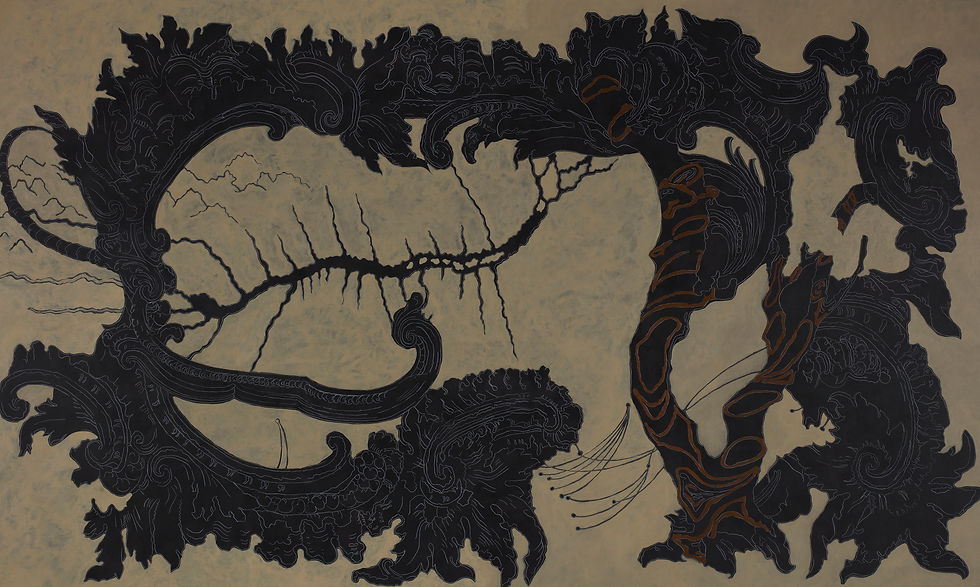%2C%202019%2C%20acrylic%20and%20ink%20on%20canvas%2C%20110cm%20x%20185cm.jpg)
Firmamento (tree), 2019, acrylic and ink on canvas, 110cm x 185cm

Firmamento (hall of antiques), 2019, acrylic and ink on canvas, 86cm x 130cm

Firmamento (mandioca), 2020, acrylics and oil on canvas, 87cm x 87cm

Firmamento (Calabash), 2020, acrylics and oil on canvas, 87cm x 87cm

Firmamento (templar castle), 2021, acrylics and oil on canvas, 125cm x 183cm

Firmamento (man over nature), 2021, acrylics and oil on canvas, 88cm x 88cm

Firmamento (nucleus), 2019, acrylic and ink on canvas, 86cm x 130cm

Firmamento 2019. Digital video and animation. Duration 6'

Firmamento 2019. Digital video and animation. Duration 6'

Firmamento 2019. Digital video and animation. Duration 6'
